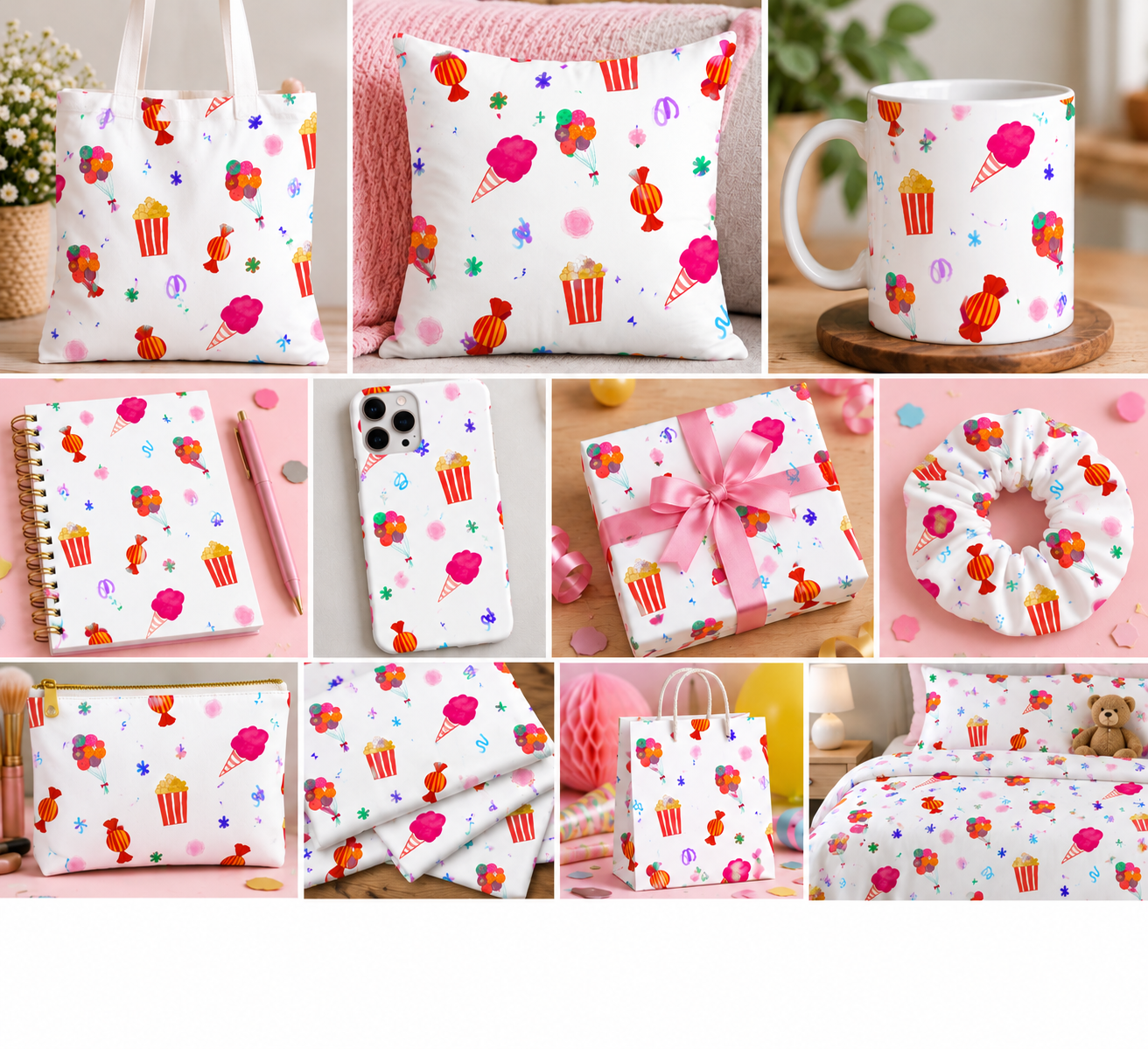
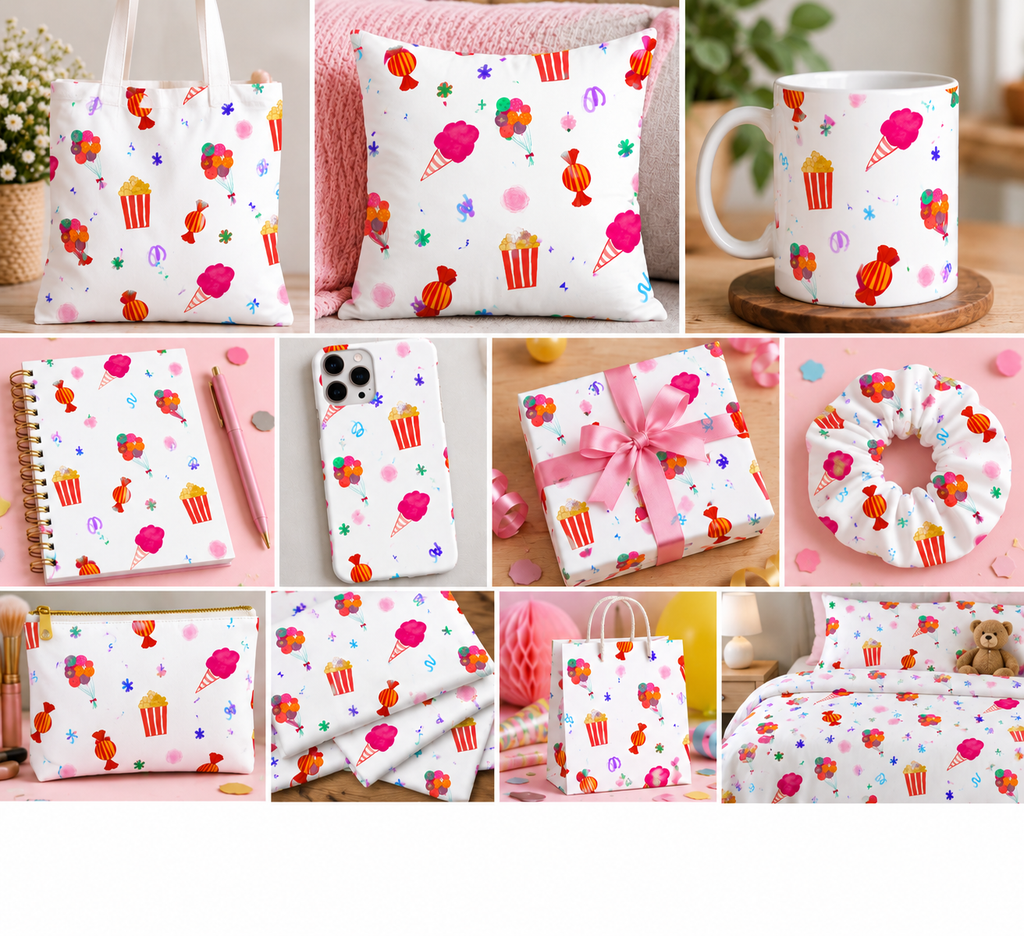
If you have ever looked at a beautiful piece of wrapping paper, fabric, wallpaper, or stationery and wondered how the design seems to continue forever without an obvious beginning or end, you were probably looking at a seamless pattern.
Seamless patterns are one of my favorite things to create because a relatively small piece of artwork can be transformed into an entire repeating surface.
But what exactly makes a pattern seamless, and what can you actually do with one?
What Is a Seamless Pattern?
A seamless pattern is a design created so that its edges connect perfectly when the image is repeated.
Imagine creating a square containing flowers, leaves, bows, baking tools, or simple geometric shapes. If the elements touching the right edge continue perfectly from the left edge—and the same happens at the top and bottom, the square can be repeated again and again without visible gaps.
That square is often called a pattern tile.
When multiple copies of the tile are placed beside one another, they create what looks like one continuous design.
Why Are Seamless Patterns So Useful?
The beauty of a seamless pattern is that you are not limited to the original size of the artwork.
The same pattern can potentially cover a small gift tag or an entire piece of fabric.
This makes seamless patterns useful for many creative projects, including:
- Fabric and sewing projects
- Gift wrapping paper
- Scrapbooking
- Digital planners
- Party favor bags
- Invitations
- Notebook covers
- Wallpaper
- Packaging
- Stickers
- Printable paper
- Phone cases
- Tumblers and mugs
- Print-on-demand products
If you enjoy crafting, sewing, Cricut projects or creating your own products, having a collection of digital patterns gives you plenty of room to experiment.
How Does a Seamless Pattern Work?
The easiest way to understand it is to imagine four copies of the same square.
Place two copies beside each other and another two underneath them.
If the pattern is truly seamless, you shouldn’t immediately be able to tell where one square ends and another begins.
That is why placement is so important when creating a pattern.
Elements shouldn’t simply be scattered randomly across a canvas. Their size, direction, spacing and relationship with neighboring elements all affect how the final repeat looks.
What Makes a Seamless Pattern Look Good?
Making a pattern technically repeat is only part of the process.
A beautiful repeat also needs balance.
1. Vary the size of your elements
Using only elements of exactly the same size can sometimes make a design feel rigid.
Try combining larger focal elements with smaller supporting elements.
For example, a garden pattern might contain large flowers, medium leaves and tiny buds.
2. Pay attention to empty spaces
One of the first things I look for when testing a pattern is an accidental empty area.
Sometimes the individual tile looks balanced, but once it repeats, four neighboring tiles create a large blank space.
Always zoom out and preview several repeats together.
3. Rotate your elements
Unless you intentionally want a directional pattern, rotating elements can make the design feel more natural.
Flowers, leaves, bows and other organic objects especially benefit from different orientations.
4. Use a limited color palette
You don’t need twenty colors to make an interesting pattern.
A small, intentional palette can make the collection feel much more cohesive.
You can also create several colorways from the same artwork.
A floral pattern, for example, could have a soft beige version, a pastel version and a darker autumn version.
5. Test the repeat
This is probably the most important step.
Don’t judge your pattern from one tile.
Repeat it several times and look for:
- obvious lines
- strange gaps
- overcrowded areas
- elements that appear too frequently
- accidental shapes created by the negative space
Sometimes moving just one small element can make the whole pattern feel more balanced.
Where Can You Use Digital Seamless Patterns?
This is where seamless patterns become really fun.
Sewing and Fabric
If you sew, you can have your own designs printed onto fabric and turn them into projects such as pouches, dresses, tote bags, cushion covers or children’s accessories.
Seeing artwork go from a digital canvas to an actual piece of fabric is one of the most exciting possibilities of surface pattern design.
Party Supplies
Seamless patterns can also be used to create coordinated party stationery.
The same pattern could appear on:
- party favor bags
- paper cups
- invitations
- food labels
- cupcake toppers
- thank-you cards
Using one pattern across several items immediately creates a coordinated theme.
Gift Wrapping
A simple repeating design can make beautiful custom wrapping paper.
You could create seasonal wrapping paper for birthdays, weddings, baby showers, Eid, Christmas or other celebrations.
Stationery
Patterns work beautifully on notebooks, planners, bookmarks, envelopes and printable papers.
This is especially useful if you like creating coordinated stationery collections rather than individual designs.
Print-on-Demand Products
Depending on the license of the pattern you purchase, seamless designs may also be suitable for products such as mugs, phone cases, fabric items and home décor.
Always check the designer’s license before using purchased artwork commercially.
Seamless Patterns vs. Regular Digital Paper
These terms are sometimes used interchangeably, but there can be an important difference.
A digital paper may simply be a finished square background.
A true seamless pattern is specifically designed so the tile can repeat continuously.
If you plan to print the design across a larger surface, especially fabric, wallpaper or wrapping paper—check that the file is actually seamless.
What File Size Should a Seamless Pattern Be?
There isn’t one required size because the correct dimensions depend on how the pattern will be used.
For printable digital designs, I personally like working with high-resolution files.
For example, a 12 × 12 inch pattern at 300 DPI is 3600 × 3600 pixels.
High-resolution files give you more flexibility for printing and crafting.
However, always check the requirements of your printer, print-on-demand company or manufacturing service before ordering a physical product.
Start Looking at Patterns Differently
Once you understand how seamless patterns work, you start noticing them everywhere.
Look at the next bedsheet, notebook, dress, wallpaper or gift bag you see.
Instead of looking at the whole design, try finding the repeat.
Where does the artwork start repeating?
Which elements are used as focal points?
How much empty space is between them?
Are the objects facing the same direction or rotating?
This is actually one of my favorite ways to learn more about pattern design.
Explore My Seamless Pattern Collection
I create seamless digital patterns inspired by everyday objects, crafts, nature, baking and simple decorative themes.
My goal is to create designs that makers can imagine beyond the digital file—on fabric, stationery, packaging, party supplies and other creative projects.
If you are looking for patterns for your next project, you can explore my latest seamless pattern designs in my DigitalMemoryCrafts Etsy shop. I share free patterns right here on my site as well, so go over to my Sketchbook to get free hand drawn patterns.
And if you’re also learning surface pattern design, I’ll be sharing more tutorials, pattern-placement ideas, Procreate tips and behind-the-scenes looks at how my patterns are created.
Happy creating!
Leave a Reply