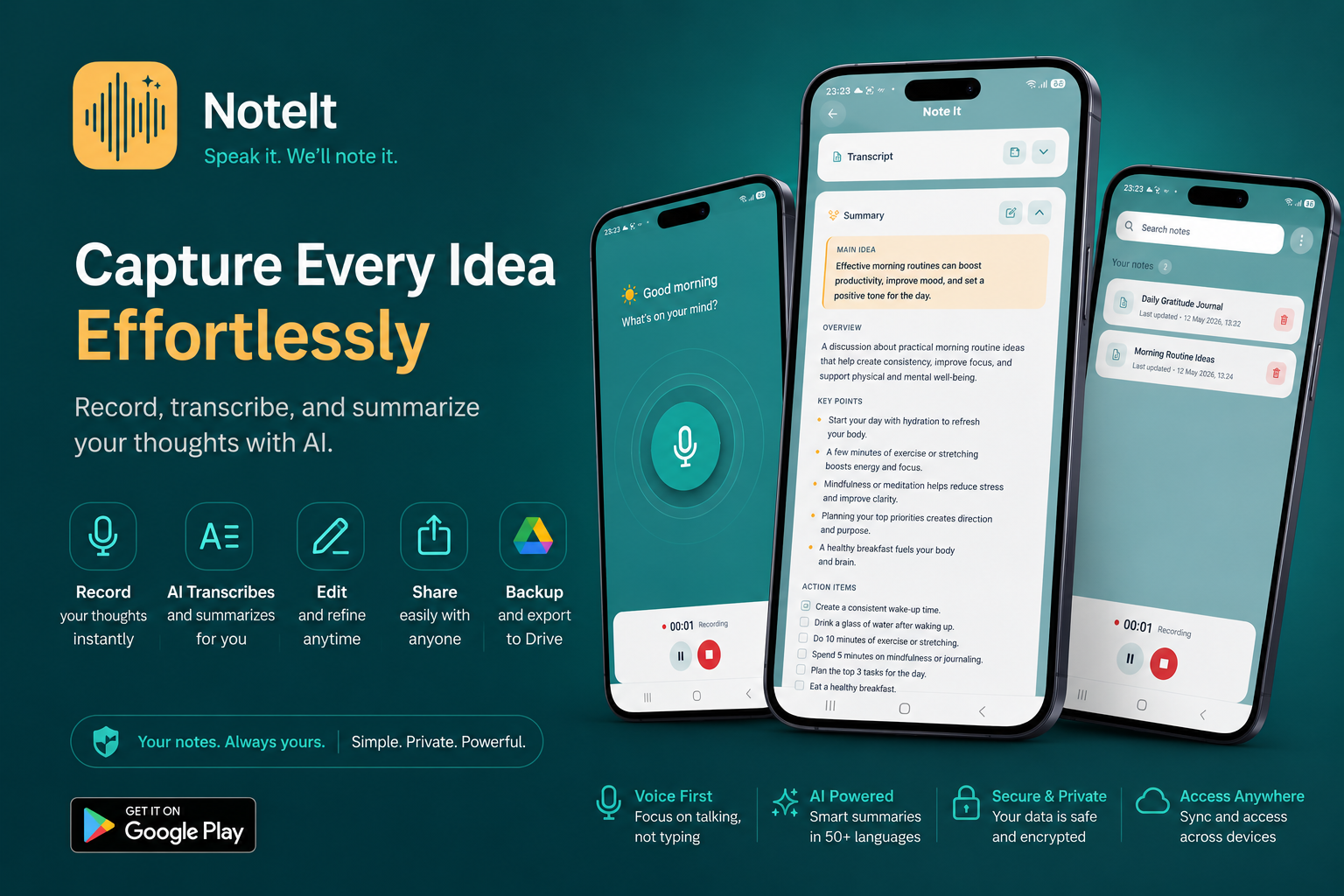
A few days ago, I published my first app on the Google Play Store.
It’s called Note It.
I know there are already countless AI note-taking apps out there. In fact, that’s probably one of the reasons I hesitated for so long. Did the world really need another one?
The answer was probably no.
But I needed one.
I’ve never been someone who consistently carries a notebook around. Even typing notes into my phone doesn’t come naturally to me. Yet ideas seem to arrive at the most inconvenient times while I’m on a bus, walking somewhere, cooking, or doing something completely unrelated.
Often, I would think, “That’s a good idea, I should remember that.”
And then I’d forget it.
What I wanted was something simple. Open the app, record a thought, and move on with my day. No complicated workflows. No endless features. No learning curve.
Just capture the idea before it disappears.
And because ideas often evolve over time, I also wanted the flexibility to revisit them later. Once a note is recorded, I can edit it, expand on it, organize it, or share it whenever I need to. Sometimes a quick thought recorded in 30 seconds can turn into a blog post, a project idea, or something worth exploring further.
So instead of continuing to search for the perfect app, I decided to build it.
Or more accurately, we decided to build it.
My husband is a software engineer as well, and throughout the process he helped shape the direction of the product. We spent time discussing the requirements, user experience, system design, and how the application should evolve over time. Many of the ideas were refined through conversations between us, and his input helped turn a rough concept into something much more practical.
Yes, I used AI extensively during development.
Some people call it vibe coding.
But I wasn’t simply asking AI to generate random code and hoping for the best. I designed the architecture, defined how I wanted the database structured, how the backend should work, how the frontend should behave, and how the different components should interact. My husband and I discussed technical decisions, system requirements, and future scalability along the way.
AI became a very capable development partner, but the engineering decisions still came from us.
One advantage of being a software engineer today is that we get to experience a unique moment in history. We have the technical knowledge to build software, and we now have AI tools that can significantly accelerate the process.
The combination is incredibly powerful.
When designing the app, we also thought about scale. Right now, there aren’t many users. But if, InshaAllah, one day there are thousands or even millions, we already have a clear idea of how the system can evolve and grow.
Will that happen? I have no idea.
For now, I’m simply happy that we finished something.
I think that’s a feeling many side-project builders can relate to.
Most ideas never make it past the planning stage. Many projects sit half-finished in private repositories. Some are started with enthusiasm and quietly abandoned a few weeks later.
This one made it all the way to the Google Play Store.
Even though there are no active users yet, it still feels rewarding to know that something which started as an idea in our conversations is now available for anyone to download and use.
If you’d like to check it out, you can find Note It here:
Note It on Google Play Store:
https://play.google.com/store/apps/details?id=com.silverlab.noteit
And if you do try it, I’d genuinely appreciate any feedback, suggestions, or reviews.
This project reminded me of something important: finishing and shipping is an accomplishment in itself.
Sometimes the biggest win isn’t building something perfect.
It’s building something real.
Leave a Reply