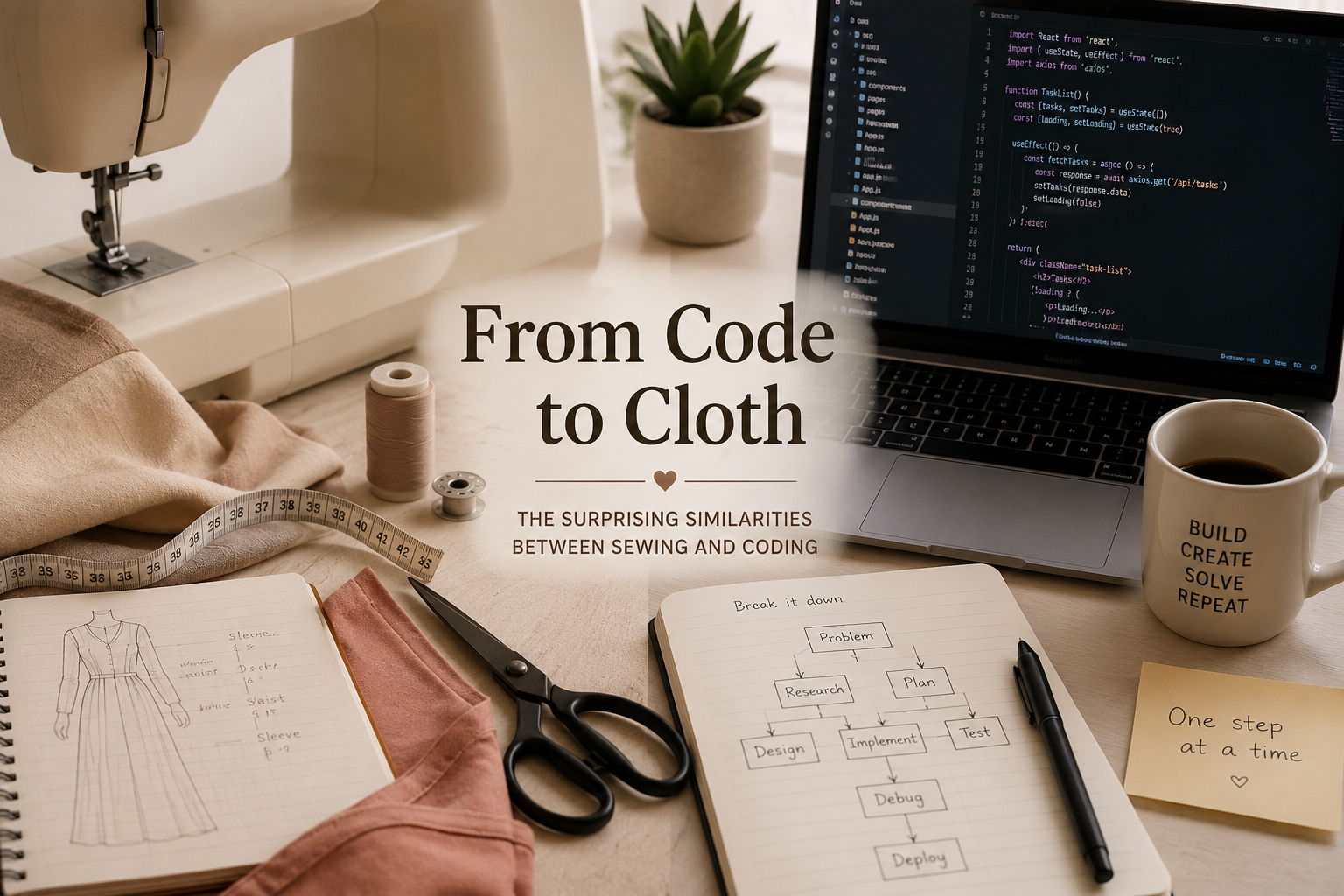
Most people would probably see sewing and software engineering as completely unrelated hobbies.
One involves fabric, scissors, and sewing machines. The other involves code, keyboards, and screens.
But the more time I spend doing both, the more I realize they are surprisingly similar.
Both Require Breaking Big Problems Into Smaller Ones
One of the first things I learned in software engineering is that large problems become manageable when you break them down into smaller pieces.
If someone asks me to build a new feature, I don’t start by writing the entire system at once. I think about the smaller components first. What services do I need? What functions need to be written? What data models are required? What libraries need to be installed? What environment variables need to be configured?
Each individual task feels manageable. Eventually, all those small pieces come together to form a complete solution.
Sewing works exactly the same way.
When I look at a finished dress or outfit, I don’t actually sew the whole garment in one go. I start by thinking about all the individual parts. There may be sleeves, bodices, collars, waistbands, pockets, facings, or cuffs. Each component is constructed separately before being attached to the others.
At first, all I see are disconnected pieces of fabric. But as each piece gets stitched into place, the garment slowly starts taking shape.
In a way, sewing feels like physically assembling functions and modules together. Every seam connects one component to another until eventually the final product appears.
Both Require Thought and Patience
Neither sewing nor coding rewards rushing.
Before I start a sewing project, I need to think about what I want to make. Then comes measuring, drafting, cutting fabric, overlocking edges, sewing seams, hemming, and finishing details.
The actual stitching is only one part of the process.
Software development is very similar.
Before writing code, I need to understand the problem I’m trying to solve. Then I break the work into smaller tasks, create services, write helper functions, define models, configure infrastructure, install dependencies, and connect everything together.
The coding itself is often just one piece of a much larger process.
From the outside, both activities can look simple. People see a finished garment or a finished application. What they don’t see are all the small decisions that happened beforehand.
Debugging Is Painful in Both Worlds
This is probably the similarity I appreciate the least.
In sewing, there is a special kind of disappointment that comes from realizing you’ve stitched something incorrectly.
Maybe a sleeve was attached the wrong way. Maybe two pieces were sewn together inside out. Maybe a measurement was slightly off.
At that point, there is usually no shortcut.
You grab the seam ripper, carefully undo the stitches, and start again.
Software engineering has its own version of this experience.
Sometimes a bug is obvious and easy to fix. Other times, you spend hours tracing through logs, reviewing code, testing assumptions, and questioning your life choices.
Occasionally, the problem isn’t even the code itself. The issue is the way the system was designed, which means stepping back and rethinking the entire structure.
Whether it’s removing stitches or refactoring code, fixing mistakes often takes longer than creating them in the first place.
Both Are Incredibly Rewarding
Despite the frustrations, this is what keeps me coming back to both.
There is something deeply satisfying about turning a pile of fabric into something wearable.
A few hours earlier, it was just material sitting on a table. Then, through a series of small steps, it becomes a dress, a skirt, or an accessory that didn’t exist before.
Software development gives me the same feeling.
Starting with a blank project and gradually building a working system never gets old. Watching individual functions, services, databases, and APIs come together into a complete application is rewarding in a way that’s difficult to explain.
In both cases, you’re creating something from nothing.
The tools are different. The materials are different.
But the process feels remarkably familiar.
Both sewing and software engineering teach me the same lesson: big things are built one small piece at a time.
Whether those pieces are lines of code or pieces of fabric, progress happens in the same way slowly, deliberately, and one stitch at a time.

Leave a Reply